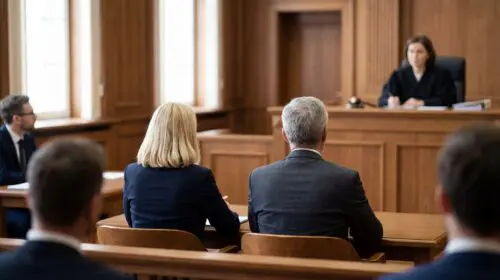


The most visible part of a domestic violence case — the courtroom, the charges, the potential jail or prison time — is rarely the whole story. A conviction also triggers a long set of collateral consequences: secondary effects that follow the defendant outside of court and often outlast the sentence itself. For many defendants and families, these collateral consequences turn out to matter as much as the direct sentence. Understanding them in advance is part of how defense counsel and clients make informed decisions about how to resolve a case.
Probation Conditions
The vast majority of California domestic violence convictions that do not involve state prison time result in probation — typically formal probation for felony convictions and informal (summary) probation for misdemeanors. Probation in a domestic violence case carries a specific set of conditions that California law largely requires by statute.
Under Penal Code 1203.097, a defendant placed on probation for a domestic violence offense must complete a 52-week Batterer’s Intervention Program (commonly called the BIP, or simply “the 52-week class”). The defendant attends a two-hour class once a week for a full year. The court conducts periodic progress reviews, and the program reports the defendant’s participation to the judge and prosecutor. Failure to attend, complete required exercises, or comply with program rules can lead to a probation violation and the original sentence being imposed — including jail or prison time that was previously suspended.
Other standard probation conditions include a mandatory protective order in favor of the alleged victim, a fine and probation revenue assessments, a domestic violence restitution fund contribution, and often a community service requirement of varying length depending on the case. Where children were present during the alleged incident, the probation conditions may also include parenting classes or supervised contact provisions.
Firearm Restrictions
California imposes some of the most aggressive firearm restrictions in the country following any domestic violence conviction. Under California Penal Code 29805 and related statutes, a misdemeanor domestic violence conviction carries a ten-year ban on owning or possessing firearms in California, which becomes a lifetime ban under federal law (the Lautenberg Amendment to the federal Gun Control Act). A felony domestic violence conviction carries a lifetime state ban as well.
The interaction between state and federal firearm law is one of the most underappreciated consequences of a domestic violence conviction. Even when California law alone would restore firearm rights after a certain period or after specific post-conviction relief, federal law often does not — and federal prosecutions for being a “prohibited person” in possession of a firearm carry their own significant exposure. For defendants whose work, hobbies, or family circumstances make firearm possession important, this consequence frequently becomes one of the most painful long-term effects of a conviction.
Employment and Professional Licensing
A domestic violence conviction shows up on private employer background checks and on the public criminal history that licensing boards review. For defendants in healthcare, education, finance, law enforcement, government employment, transportation, or any other field that requires a clean background, the conviction can be career-ending. Professional licensing boards (medicine, nursing, law, real estate, contracting, teaching, and others) have their own discipline processes and can suspend, restrict, or revoke a license based on the conviction.
For employers without licensing rules but with conduct-based hiring policies, the conviction often disqualifies the applicant from consideration outright. Post-conviction relief — most commonly Penal Code 1203.4 expungement after successful completion of probation — can change the calculus for many private background checks. The PC 1203.4 page explains the eligibility and process. PC 17(b) reductions are also available for some wobbler convictions, which can convert a felony conviction on record to a misdemeanor.
Immigration Consequences
For non-citizens, a domestic violence conviction is one of the most consequential events that can happen in immigration status. Federal immigration law identifies “crimes of domestic violence” as deportable offenses under 8 U.S.C. § 1227(a)(2)(E). Lawful permanent residents can face deportation; visa holders can face deportation and reentry bars; applicants for adjustment of status can find their applications denied; and naturalization can be blocked.
The immigration analysis is highly fact-specific and depends on the specific statute of conviction, the elements the prosecution proved, and the language of the plea. Defense counsel handling cases with non-citizen defendants typically work in coordination with immigration counsel to structure any plea so that the underlying conviction is the least immigration-damaging available outcome. This is one of the areas where pre-plea analysis can make a decisive difference.
Housing and Family Consequences
A protective order typically requires the defendant to move out of a shared residence with the protected person, even when the defendant is the named lessee, the mortgage holder, or the property owner. The financial obligations on the residence continue regardless. Defendants often find themselves paying rent or mortgage on a residence they cannot enter, while also paying for separate housing during the pendency of the case and any probation period.
Family consequences are similarly substantial. Under Family Code 3044, a recent finding of domestic violence creates a rebuttable presumption against the offending parent being awarded custody. The presumption can be overcome with specific evidence — counseling completion, ongoing parenting education, demonstrated change — but the burden in custody proceedings shifts dramatically. For families with children, the custody implications of a domestic violence finding can be more lasting than any criminal sentence.
Common Questions
Does expungement under PC 1203.4 restore firearm rights?
Generally, no. A PC 1203.4 dismissal does not restore firearm rights that were lost through the domestic violence conviction. The federal Lautenberg Amendment treats the conviction as a continuing prohibition even after California-level post-conviction relief. Restoration of firearm rights, where available at all, typically requires separate procedures and may not be available for federal purposes.
Will the 52-week class fit around a full-time job?
Most certified Batterer’s Intervention Programs offer evening and weekend sessions specifically to accommodate working participants. Some offer hybrid or remote options, though the rules around remote attendance have changed over time and depend on the court’s current orders. The court does require attendance at scheduled sessions — work cannot be a routine excuse for missed classes — but most programs are designed to be workable for people maintaining employment.
Can a domestic violence conviction affect a teaching credential or nursing license?
Yes, and these boards typically have their own discipline procedures that operate independently of the criminal court. The California Commission on Teacher Credentialing, the Board of Registered Nursing, and other licensing boards have authority to take action — suspension, restriction, or revocation — based on the conviction. Defense counsel handling cases for licensed professionals often coordinates with administrative counsel familiar with the relevant board.
If the conviction is a misdemeanor, are the consequences much smaller?
The criminal sentence is typically smaller for a misdemeanor — county jail rather than state prison, shorter probation, lower fines. But the collateral consequences are largely the same. Firearm restrictions, immigration consequences, professional licensing issues, and family law implications generally apply equally to misdemeanor and felony domestic violence convictions. This is one of the reasons defense work focuses on charge reduction as well as sentence reduction.
The collateral consequences of a domestic violence conviction are often more decisive than the direct sentence. Effective defense work begins with an honest assessment of what is at stake — not only the criminal exposure but the long-term effects on employment, family, firearms, immigration, and housing — and structures a strategy that accounts for all of them. Joseph W. Galasso has defended domestic violence cases in Riverside County for more than 20 years, with attention to both the criminal case and its downstream consequences. To discuss a specific situation, schedule a free case evaluation or call (951) 225-4130.